Curator's Take
AI Commentary
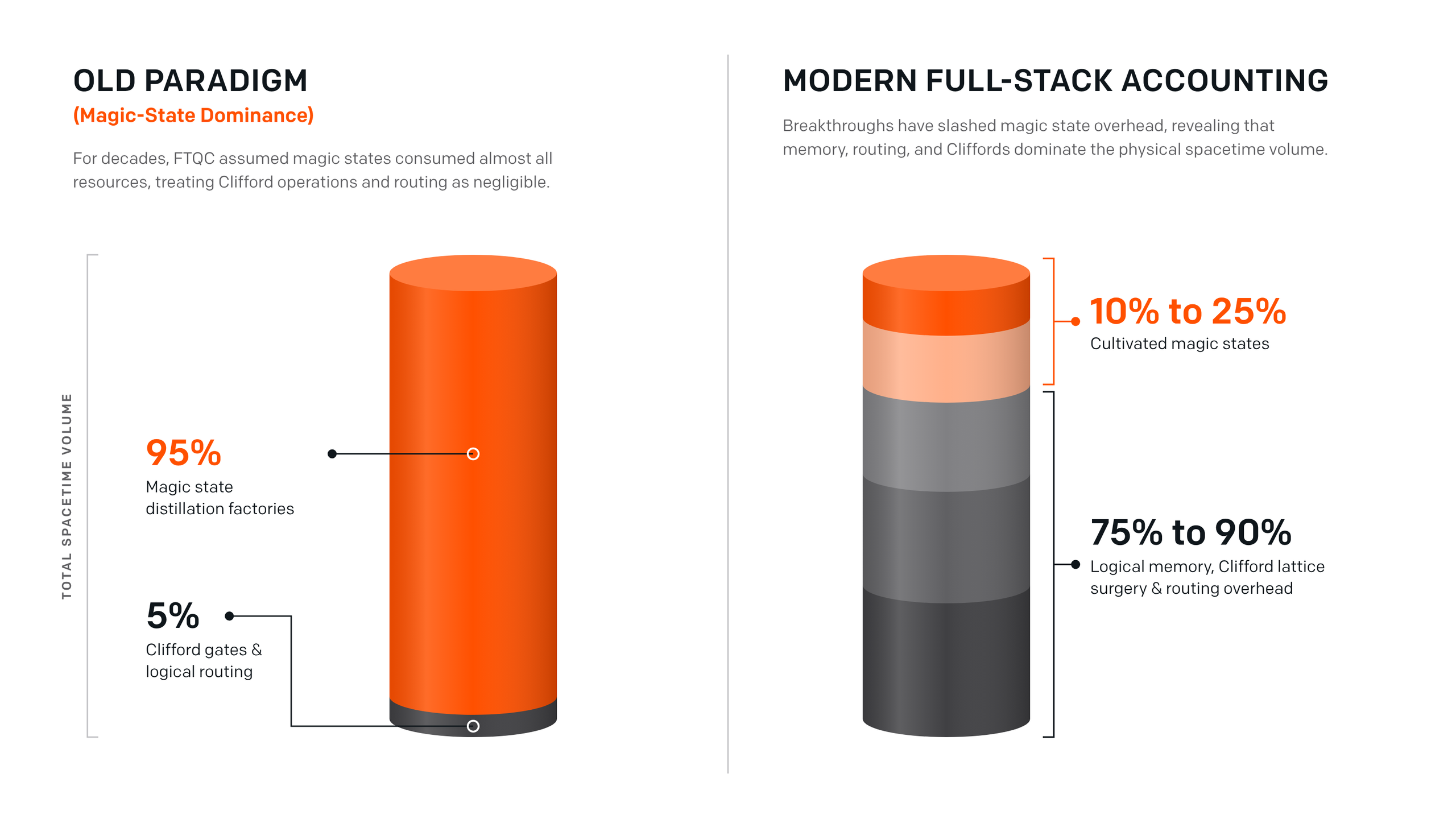
This article matters because it overturns the long‑standing assumption that cutting non‑Clifford gate counts alone drives fault‑tolerant performance, showing instead that magic‑state preparation efficiencies have shifted the bottleneck to routing overhead, Clifford operations and qubit idle times. By quantifying how these factors dominate the physical spacetime volume, IonQ and Classiq make a strong case for full‑stack compilation tools that co‑optimize logical circuits, error‑correction codes and hardware layout—a direction echoed by recent efforts at Google and IBM to integrate surface‑code aware schedulers. Readers should take away that future resource estimates will need to account for architecture‑level trade‑offs, not just algorithmic gate counts, before realistic quantum advantage timelines can be set.
— Mark Eatherly
Summary
IonQ and Classiq's analysis shows that minimizing non-Clifford gates is no longer the primary factor in fault-tolerant quantum computing performance. Advances in magic state preparation mean that routing, Clifford gates, and memory retention now significantly impact the overall physical spacetime volume. Therefore, a full-stack compilation approach considering physical layouts and error correction is crucial for accurate evaluation of fault-tolerant algorithms. The post IonQ and Classiq Outline Architectural Trade-Offs in Fault-Tolerant Resource Estimation appeared first on Quantum Computing Report .