Curator's Take
AI Commentary
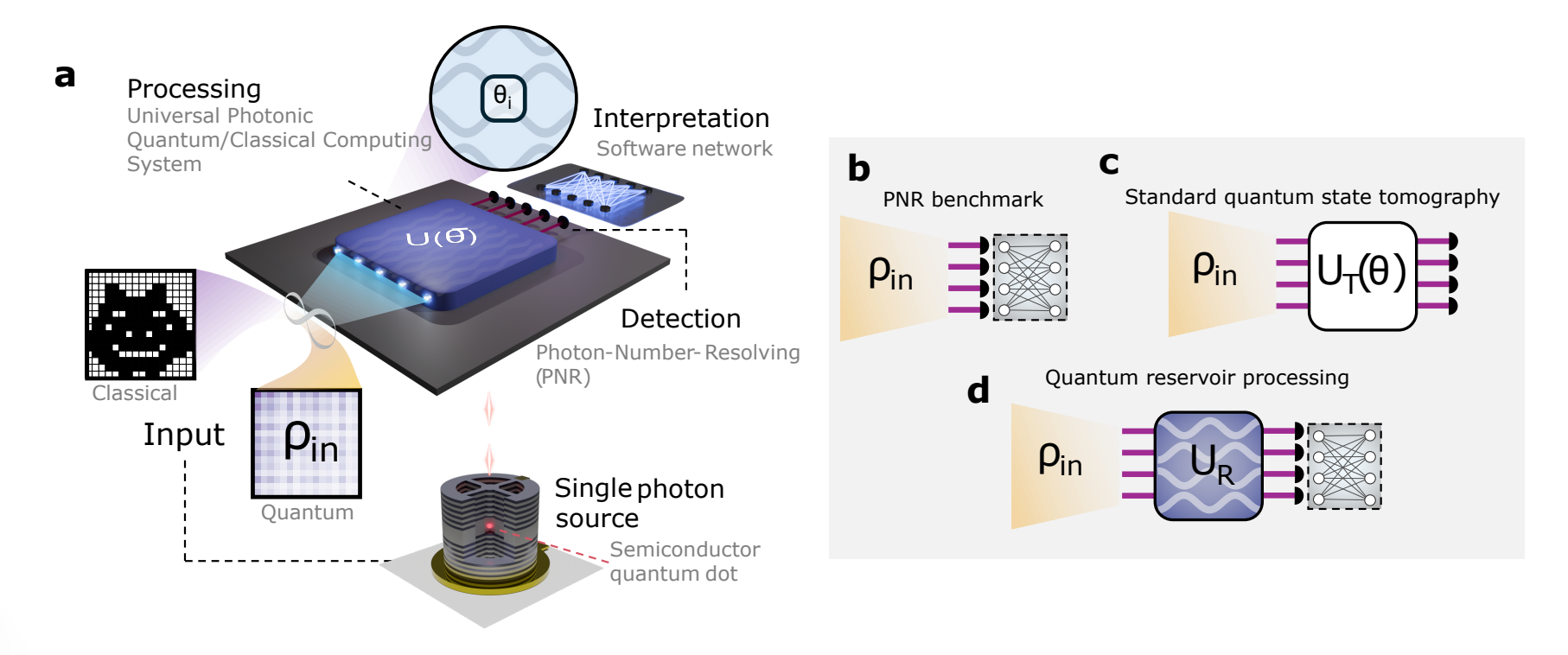
This article showcases the first experimental realization of a photonic quantum reservoir processor that can tackle both classical and quantum machine‑learning workloads while also performing single‑basis quantum state tomography, demonstrating a versatile hardware primitive beyond gate‑based approaches. By leveraging time‑multiplexed light pulses in a scalable architecture, Quandela’s team bridges recent advances in optical quantum processors with the growing demand for near‑term QML accelerators, complementing efforts such as Xanadu’s photonic tensor networks and IBM’s noisy‑intermediate‑scale quantum (NISQ) algorithms. The work hints at practical routes to embed machine‑learning inference directly into photonic chips, though performance metrics still need benchmarking against classical reservoirs and larger qubit‑based models before commercial impact can be assessed.
— Mark Eatherly
Summary
Photonic quantum processing unit for quantum and classical machine learning tasks. A collaborative research group consisting of quantum information scientists from Quandela, the Center for Theoretical Physics of the Polish Academy of Sciences, and the University of Warsaw has experimentally demonstrated a scalable physical Quantum Machine Learning (QML) architecture. Supported by the European Union’s Horizon [...] The post Quandela Demonstrates Photonic Quantum Reservoir Processing for Advanced Machine Learning and Single-Basis Quantum Tomography appeared first on Quantum Computing Report .