Curator's Take
AI Commentary
This article shows that a hybrid quantum‑classical workflow can finally reach chemical accuracy on notoriously difficult strongly correlated iron oxides, a class of materials that have long frustrated conventional electronic‑structure methods. By deploying Sample‑based Quantum Diagonalization on IBM’s superconducting processors and feeding it tight‑binding models derived from ab initio data, the Los Alamos–QC Ware team not only reproduced experimental ground states for FeO and Fe₂O₂ but also outperformed state‑of‑the‑art classical approaches, hinting at a scalable path toward bulk periodic simulations. The result demonstrates that near‑term quantum hardware can already add tangible value to materials science, though further improvements in qubit fidelity and error mitigation will be needed before routine industrial deployment.
— Mark Eatherly
Summary
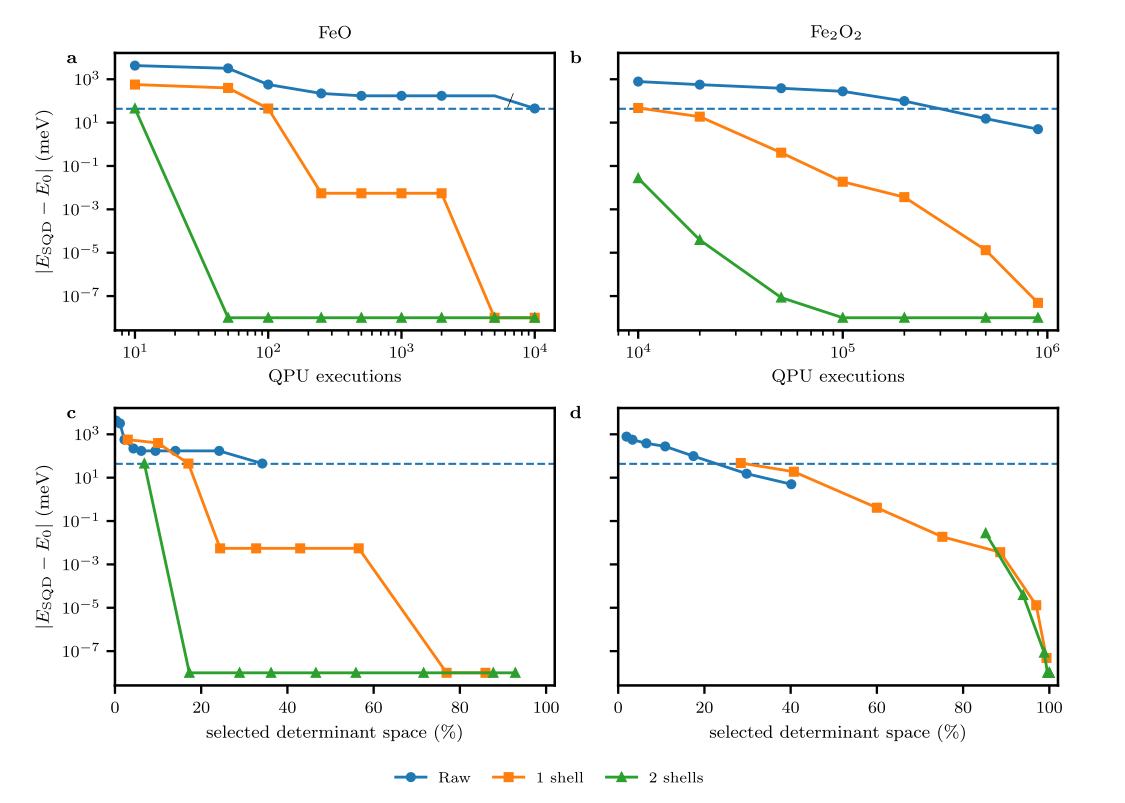
Researchers from Los Alamos National Laboratory and QC Ware developed a hybrid quantum-classical workflow to simulate strongly correlated transition metal oxides. They used Sample-based Quantum Diagonalization (SQD) on IBM Quantum hardware, coupled with ab initio-informed d–p tight-binding models, to achieve chemical accuracy in modeling diatomic iron monoxide (FeO) and rhombic iron oxide dimers (Fe2O2). This method successfully recovered experimental ground states and outperformed traditional computational methods, establishing a new approach for modeling bulk periodic FeO. The post Los Alamos and QC Ware Model Correlated Iron Oxides Using Sample-Based Quantum Diagonalization on IBM Hardware appeared first on Quantum Computing Report .