Curator's Take
AI Commentary
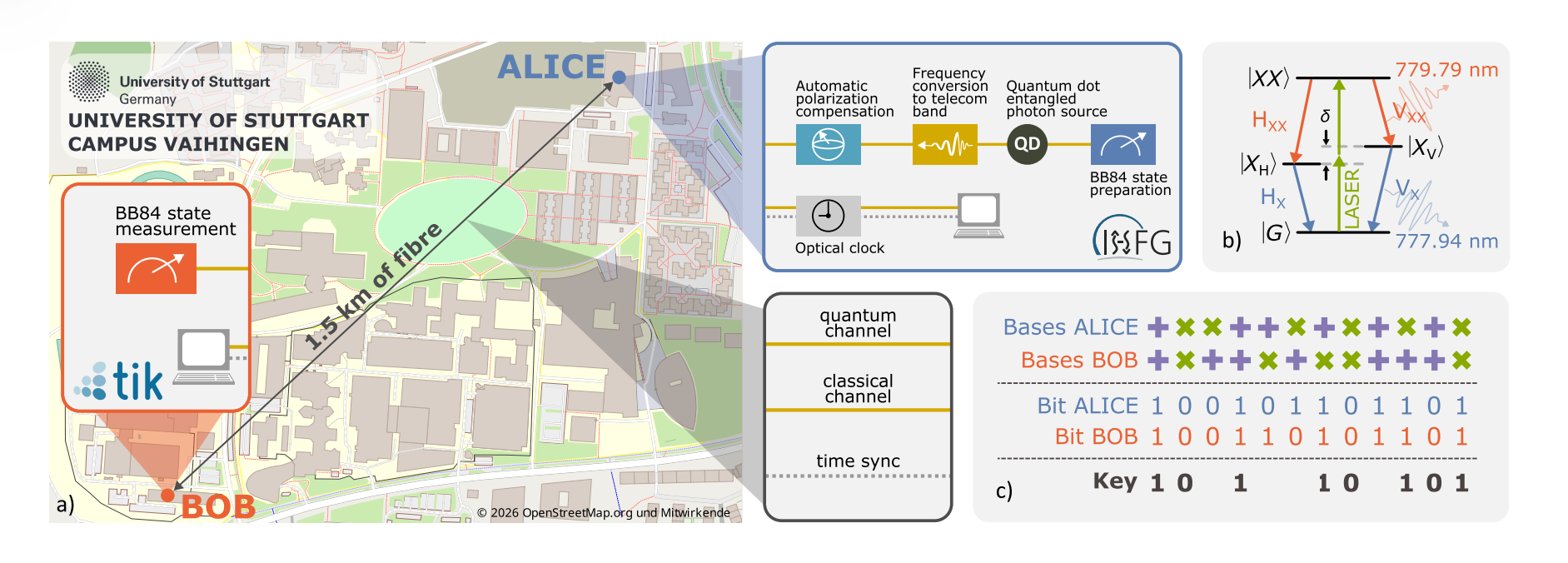
This article marks the first real‑world deployment of an entanglement‑based QKD link that relies on a quantum‑dot photon source combined with frequency conversion, showing that semiconductor emitters can now deliver metropolitan‑scale secure keys at practical rates. By generating 14.2 Mbit of key material over just 1.6 km of campus fiber and using it for one‑time‑pad image encryption, the work bridges laboratory demonstrations and operational quantum‑secure networks, complementing recent advances in fiber‑based QKD with atomic or nonlinear sources. The result suggests that compact, electrically driven quantum‑dot devices could become a cost‑effective backbone for future city‑wide cryptographic infrastructure, though scaling to longer distances will still require further loss mitigation and integration with existing telecom hardware.
— Mark Eatherly
Summary
The University of Stuttgart, in collaboration with Saarland University and Leibniz IFW Dresden, successfully deployed an entanglement-based quantum key distribution (QKD) link using a quantum dot photon source. The system generated 14.2 Mbit of secure key material over a 1.59 km fiber link, achieving one-time pad image encryption. This demonstrates the viability of quantum dots with frequency conversion for metropolitan quantum key networks. The post University of Stuttgart Deploys Quantum Dot QKD Link Using Frequency Conversion Over Campus Fiber appeared first on Quantum Computing Report .