Curator's Take
AI Commentary
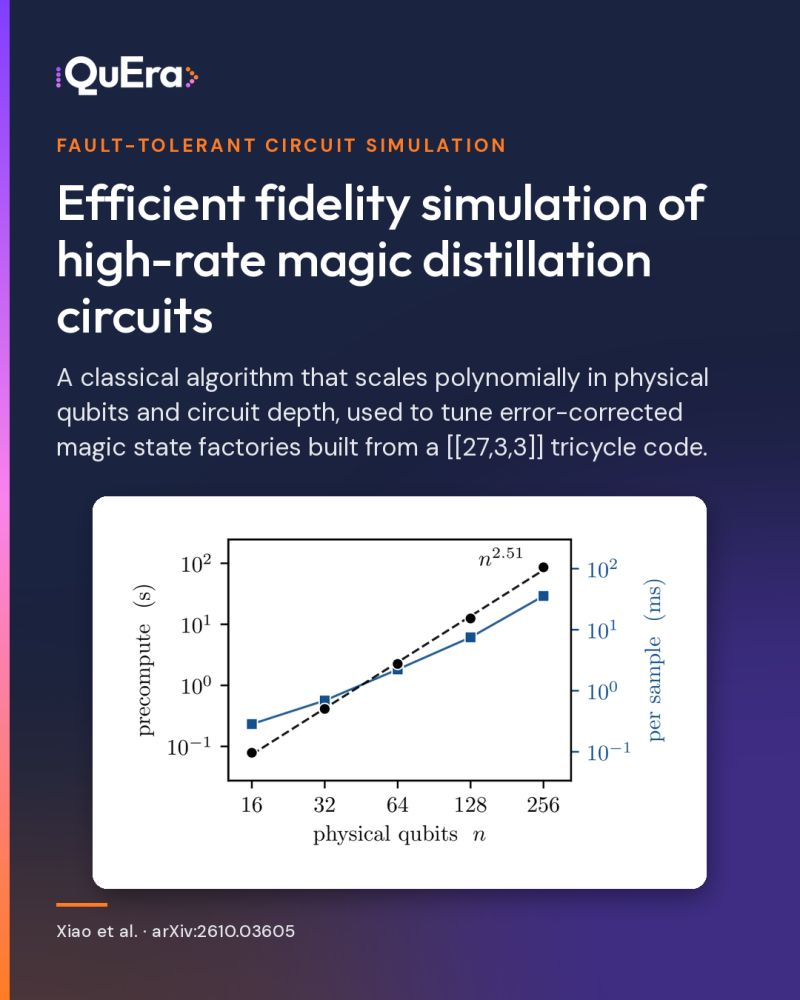
This article matters because it delivers the first scalable classical tool for rigorously benchmarking the non‑Clifford components that make fault‑tolerant quantum computers universal, a task that has long been limited to small, brute‑force simulations. By turning arbitrary Pauli faults into Clifford operations and using Monte Carlo sampling, the method can evaluate logical fidelity on circuits with hundreds of physical qubits—far beyond prior capabilities—and it already highlights design choices such as shared ancilla blocks that boost magic‑state factory efficiency. In the broader landscape, the technique gives hardware teams at QuEra, IBM, Google and others a practical way to predict real‑world performance before costly experimental runs, accelerating the path toward usable error‑corrected processors. The results are still limited to circuits where the fault model fits the backpropagation scheme, so further extensions will be needed for more exotic noise sources.
— Mark Eatherly
Summary
Researchers developed a polynomial-time Monte Carlo method for benchmarking fault-tolerant non-Clifford quantum circuits, which are essential for universal quantum computation. This method efficiently simulates complex circuits and evaluates logical fidelity by backpropagating Pauli faults and reducing errors to Clifford operators. They demonstrated its effectiveness on circuits up to 256 physical qubits and various magic-state factory designs, finding that a shared ancilla block significantly improves efficiency. The post QuEra, Harvard, and UMD Researchers Develop Polynomial-Time Classical Benchmarking for Non-Clifford Fault-Tolerant Circuits appeared first on Quantum Computing Report .