Curator's Take
AI Commentary
This article demonstrates a practical step toward nationwide quantum‑secure communications by showing that free‑space QKD can be seamlessly bridged into existing fiber backbones using adaptive optics and high‑efficiency superconducting detectors. The 18‑kilometre air link, delivering roughly 1 kbps of secret key material, rivals earlier ground‑only experiments while offering the flexibility needed for metropolitan or satellite‑to‑ground networks. By proving that atmospheric turbulence can be tamed and that hybrid links scale to real‑world telecom infrastructure, the work moves quantum cryptography closer to commercial deployment, though further improvements in key rate and weather robustness will still be required.
— Mark Eatherly
Summary
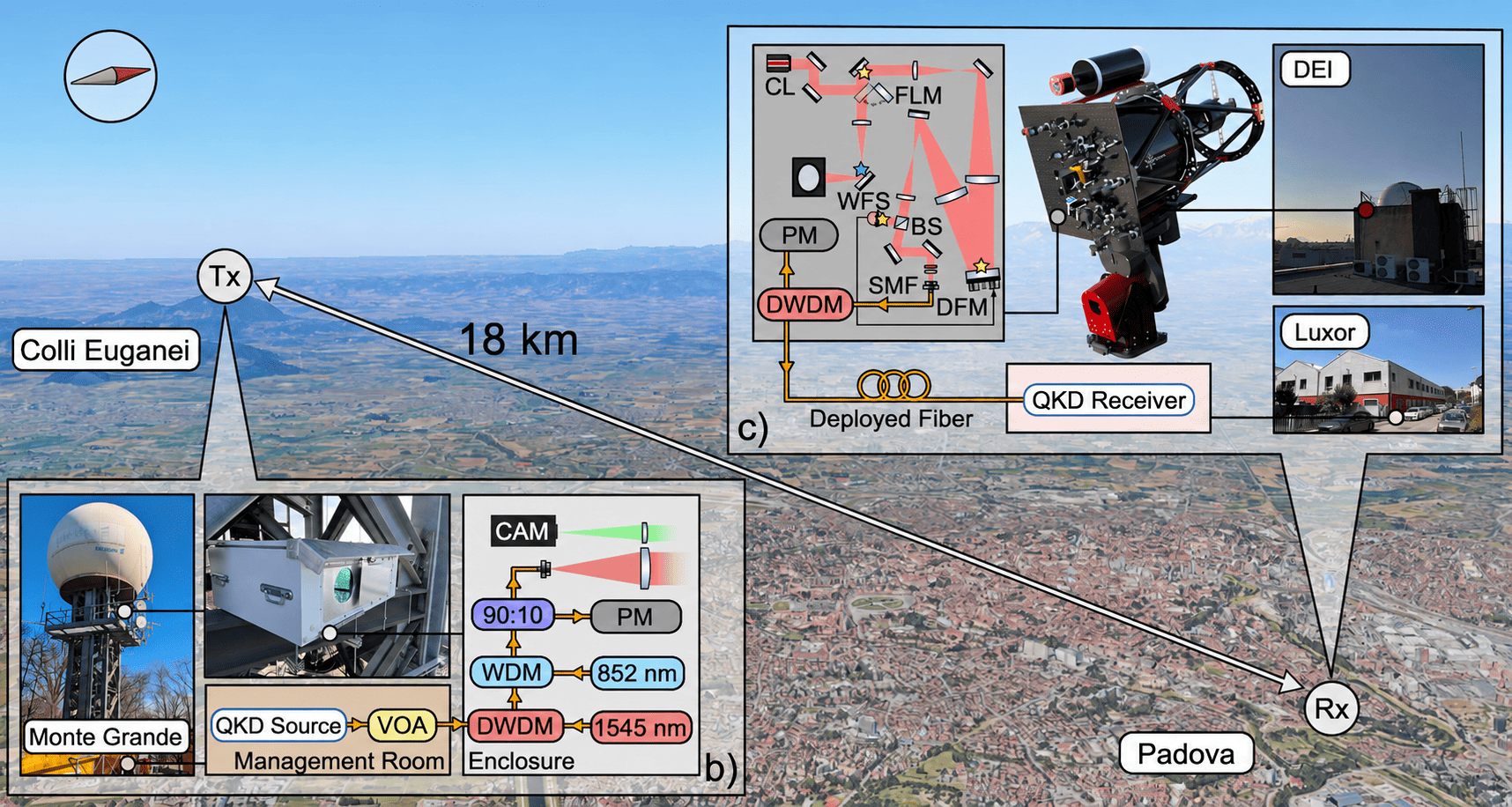
Insider Brief Researchers demonstrated quantum key distribution across an 18-kilometer free-space link by using adaptive optics to counter atmospheric turbulence and connect the signal to conventional fiber infrastructure. The field trial in northeastern Italy generated secret encryption keys at an average rate of about 1,000 bits per second with high-efficiency superconducting detectors and 200 bits […]