Curator's Take
AI Commentary
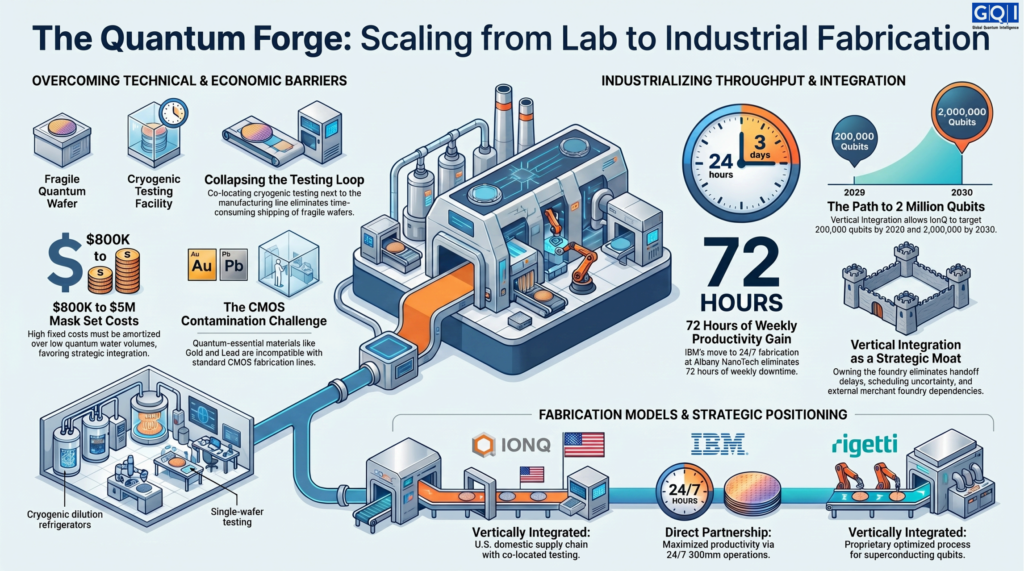
This article highlights that the real bottleneck for scaling quantum processors is not just adopting CMOS‑compatible designs, but achieving high wafer‑per‑hour throughput and rapid design‑to‑test cycles—metrics that directly dictate how quickly new qubit architectures can be iterated and commercialized. By dissecting the IonQ‑SkyWater acquisition, it shows how a traditional semiconductor foundry’s volume‑manufacturing expertise could compress iteration times from months to weeks, potentially accelerating roadmap milestones for superconducting, spin‑qubit, and photonic platforms alike. The piece underscores that economic viability will hinge on marrying quantum‑specific device performance with the economies of scale already mastered by the CMOS industry, a convergence that could reshape funding priorities and supply‑chain strategies across the field.
— Mark Eatherly
Summary
By Mohamed Abdel-Kareem Moving to standard CMOS wafer manufacturing is very helpful for certain modalities but not all. The real competitive advantages come from fabrication throughput—measured in wafers per hour (WPH)—and cycle time (i.e. the time from design submission to tested device). This is where manufacturing economics meets quantum roadmaps. The IonQ-SkyWater Acquisition: A Case [...] The post Manufacturing Throughput, Iteration Speed, and the Economics of Fabrication appeared first on Quantum Computing Report .