Curator's Take
AI Commentary
This article marks the first time quantum measurement contextuality has been verified on a two‑dimensional processor with more than a hundred qubits, showing that even large‑scale superconducting arrays can maintain the delicate non‑classical correlations required for genuine quantum advantage. By turning contextuality into a hardware benchmark, Google’s work provides a new diagnostic for coherent control errors that complements existing fidelity metrics and informs error‑correction thresholds for fault‑tolerant architectures. The result also bolsters confidence that future molecular‑simulation algorithms can exploit such deep quantum effects on near‑term devices, although scaling the demonstration to even larger systems will still demand tighter noise suppression.
— Mark Eatherly
Summary
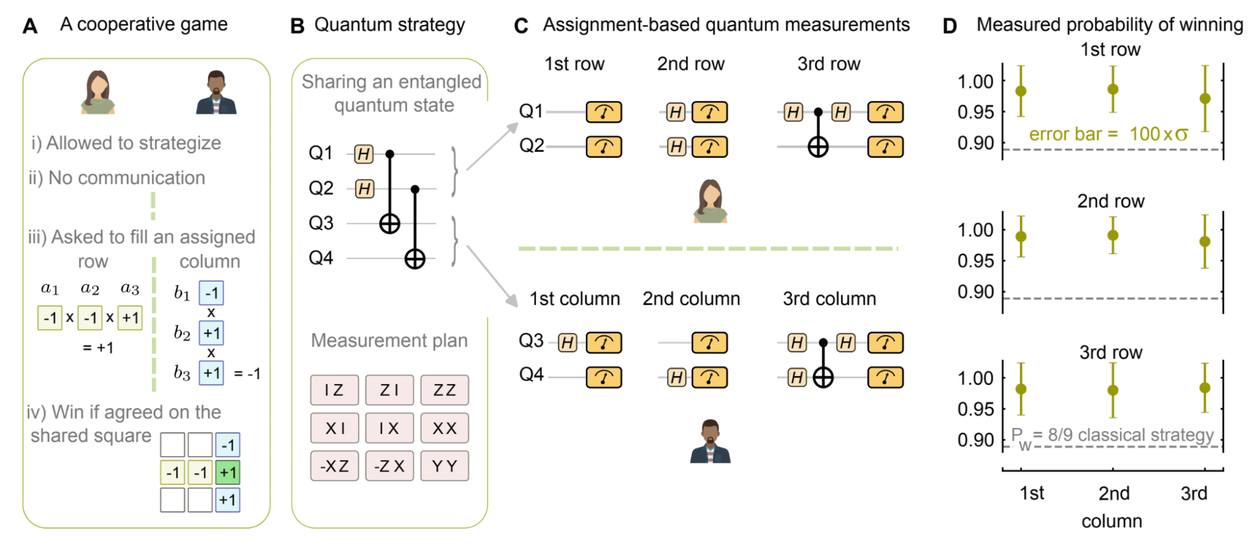
Google Quantum AI has demonstrated quantum measurement contextuality on 72-qubit and 105-qubit Willow processors, moving contextuality testing to large two-dimensional qubit arrays. This research, published in Science, establishes a hardware benchmark for coherent control errors and has implications for fault-tolerant computing and molecular simulations. The experiments verified that quantum observables do not have predetermined values independent of compatible measurements. The post Google Quantum AI Demonstrates Measurement Contextuality Across 105 Qubits on Willow Processors appeared first on Quantum Computing Report .