Curator's Take
AI Commentary
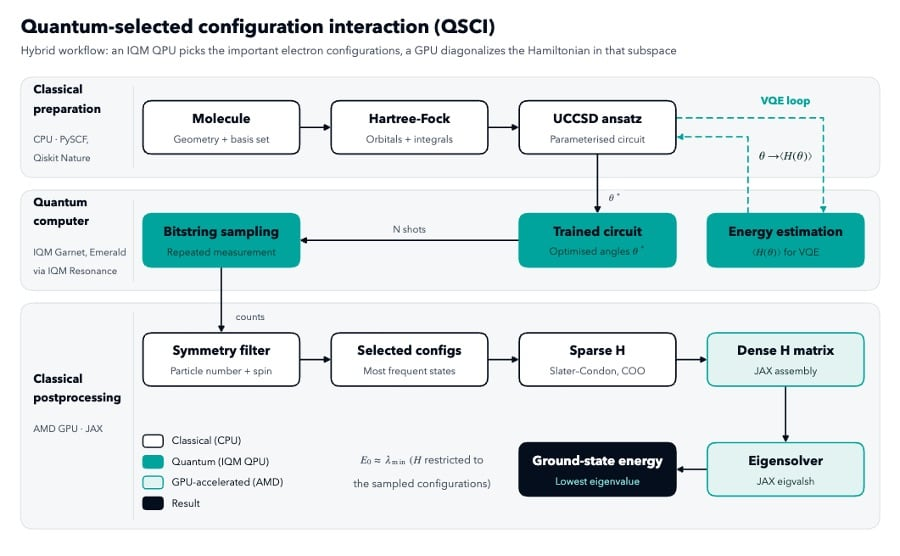
This article shows the first reproducible end‑to‑end chemistry workflow that couples a 20‑qubit superconducting QPU with AMD’s ROCm‑enabled GPUs, proving that multi‑vendor hardware stacks can be integrated into existing supercomputing ecosystems. By delivering ground‑state energy estimates for molecular systems in an open‑source Jupyter notebook, the work bridges the gap between noisy intermediate‑scale quantum (NISQ) processors and high‑performance classical accelerators, echoing recent pushes toward standardized hybrid pipelines such as IBM’s Qiskit Runtime. The demonstration signals that practical quantum advantage in computational chemistry may emerge sooner than expected, provided error mitigation and scaling challenges are addressed.
— Mark Eatherly
Summary
IQM Quantum Computers and AMD have successfully demonstrated a hybrid quantum-classical computational chemistry workflow. This workflow utilizes IQM's 20-qubit Garnet processor and AMD Instinct GPUs with ROCm software to perform molecular ground-state energy calculations. The collaboration provides a multi-vendor solution for supercomputing centers and is available as an open-source Jupyter notebook for further development. The post IQM and AMD Demonstrate Reproducible Hybrid QPU-GPU Chemistry Workflow Using ROCm appeared first on Quantum Computing Report .